Search results for tag #ansible
![[?]](https://media.bsd.cafe/bsdmmedia01/accounts/avatars/115/276/840/417/131/111/original/507e2134cf9f2a8d.webp)
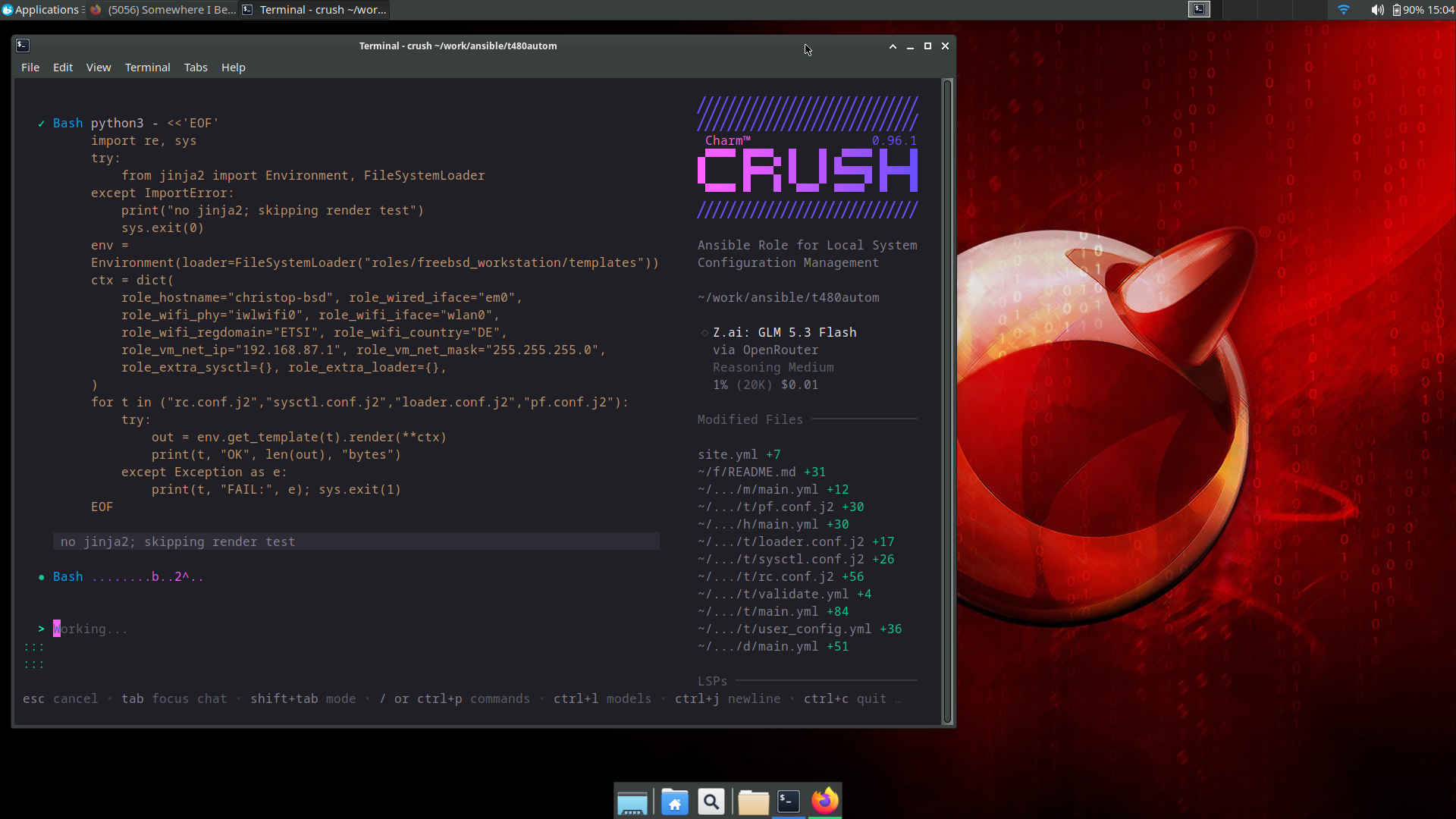
How to annoy two purist camps at once:
1. Run FreeBSD 15.1-RELEASE on a ThinkPad T480.
2. Let an agentic AI (Crush + GLM 5.3 Flash) write the Ansible roles for rc.conf, pf.conf, and loader.conf.
I know AI isn't the most popular topic around here, but watching a TUI agent haggle with a missing Jinja2 module in real time is great entertainment for a single cent. And the result was actually good after reviewing and tweaking it just a little.
#FreeBSD #RunBSD #ThinkPad #T480 #Ansible #DevOps #bsdcafe #ai #genai
Alt...
A desktop screenshot of a FreeBSD system featuring the red Beastie daemon wallpaper. An open terminal window runs the Charm Crush CLI agent (v0.96.1) inside the directory ~/work/ansible/t480autom. The right pane displays the Crush logo, context info showing the model "Z.ai: GLM 5.3 Flash via OpenRouter", and a list of modified Ansible and template files including site.yml, rc.conf.j2, sysctl.conf.j2, pf.conf.j2, and loader.conf.j2. The left pane shows an automated bash execution running an inline Python test using Jinja2 to render configuration templates with network parameters for host 'christop-bsd'.
![[?]](https://social.heinlein-support.de/system/accounts/avatars/110/252/860/087/317/313/original/f1ed83aa65d426dc.png)
Die neuen #Linux-Schulungen unserer Akademie sind online und buchbar. Neben beliebten Klassiker-Themen von #Ansible bis #systemd haben wir drei ganz neue Kurse frisch ins Programm aufgenommen:
➡️ Mailcluster mit Ansible
➡️ Linux-Systemhärtung
➡️ Workshop zu #Kea & #PowerDNS
Noch Weiterbildungsbudget für 2026? Wir haben noch Plätze in Linux-Kursen bis Jahresende.
Jetzt anmelden:
👉 https://www.heinlein-support.de/news/kursprogramm-linux-akademie-2027-online
#LinuxSchulungen #HeinleinAkademie #LinuxKurse #Systemhärtung

Alt...
Linux-Schulungen: Zwei Männer schauen auf Laptop
![[?]](https://gyptazy.com/fedi/gyptazy/s/avatar-1aa83a84ee47c864bc90216a89d0efcf.png)
When talking about open-source virtualization platforms, Proxmox VE is probably one of the first solutions that comes to mind. It combines KVM virtual machines, LXC containers, storage, networking and clustering behind a convenient management interface.
But what if you want to build the same kind of environment on FreeBSD?
This is exactly where Sylve becomes interesting.
https://gyptazy.com/blog/sylve-freebsd-ansible-module-automation/
As people kept asking for the modules I developed for my @BoxyBSD@bsd.cafe project, I just made them shiny and prepared them for pushing them upstream.
Making the switch easier for people coming from #Proxmox, it uses mostly the same syntax as the Proxmox modules to keep the interface similar. Next to this, they're built in an equal way with a shared authentication module util, to make sure new modules can directly use the same authentication lib.
Currently it comes:
.
├── LICENSE
├── module_utils
│ └── sylve_common.py
├── modules
│ ├── sylve_jail.py
│ └── sylve_vm.py
![[?]](https://m5l.eu/u/marek/s/avatar-ff8999a3b20360a58bc1da5859b98e8a.png)
- switching between #Zig versions, I liked it more than the dedicated anyzig
- #Python venv activation – it's silly but feels so good, and collaborates with uv
- ensuring I have the right language server and formatter for a project, be it #Lua, #TypeScript, and trying out various options for Python
- setting LANG="C.UTF-8" only in the specific project folder because #Ansible refused to work with Polish...
The final boss was getting a really comfortable Tree-sitter setup: get the #Rust CLI, write grammar in #JavaScript, re-generate and run tests on source change as a mise Task. And then I only cloned the repo on another machine and was ready to go!
This post was written as a more cultured outlet for my excitement instead of aggresively committing mise.toml into every repository I touch
inotifywait --monitor --recursive ~/.configThis shows me what files are changed when I click "Apply". This way I don't need to wade through pages of config file documentation, but I still know what I need to reproduce.
This time it's #Debian with #Docker. I used to avoid containers, preferring to run services directly instead. But setting up backups made me appreciate the separation between the application data in image and persistent state in mounted volumes. The final piece that convinced me is the ability to self-host my own container registry with @forgejo@floss.social
I'm doing the initial setup through #Ansible (learned from @notthebee@tilde.zone), but specific applications are managed via dockge. The ambition to do every adjustment through playbooks burns out really fast when working with a single instance.