![[?]](https://m5l.eu/u/marek/s/avatar-ff8999a3b20360a58bc1da5859b98e8a.png)

Alt...
meme format "bro explaining" featuring a man excitedly talking and gesturing to a nearby woman with an absent expression
...
![[?]](https://media.hachyderm.io/accounts/avatars/109/576/359/101/895/681/original/68d7e11cefddd065.jpeg)
![[?]](https://media.infosec.exchange/infosec.exchange/accounts/avatars/114/755/433/237/136/565/original/0942784840d57ef5.jpeg)

Są już jakieś stabilne narzędzia do auto-repostowania tu treści z X (albo z Fb, Li)?
...
Older...
![[?]](https://storage.waw.cloud.ovh.net/v1/AUTH_74714a37e6e24c7fb695d79be309da62/101010public/accounts/avatars/115/349/541/757/107/777/original/efc75ae02dc4f789.jpg)
![[?]](https://storage.waw.cloud.ovh.net/v1/AUTH_74714a37e6e24c7fb695d79be309da62/101010public/accounts/avatars/109/083/006/843/258/005/original/0d549a3b4f4292da.png)
![[?]](https://cdn.masto.host/enosmtown/accounts/avatars/108/562/003/765/857/559/original/cb6d780071c6da37.jpg)
@niebezpiecznik_pl Ze wszystkiego, z czego wyciągniesz rss. Atom chyba też może być. Rss parrot się to nazywa.
![[?]](https://pcdn.mastodon.com.pl/accounts/avatars/113/174/800/171/259/064/original/364f0c3c65059068.png)
X - były ale x je aktywnie zwalcza i pozywa.
FB - były, ale fb powyłączał wszystkie api które do tego służyły.
Li - nie wiem.
Zamknięte ogrody są pilnowane przez ich właścicieli, nie czekaj na stabilne narzędzia, gdy społeczność próbująca je tworzyć jest pozywana i zastraszana (case nitter/XCancel). To wybór bigtech by ich nie było, taki przyjęli model biznesowy.
Kiedyś do korzystania z fb mogłeś używać Friendica, a czat fb był oparty o xmpp. Wyłączono to.
Kiedyś do korzystania z x mogłeś używać innych aplikacji niż właściciela, dane twitków były dostępne dla narzędzi. Musk to powyłączał i ściga autorów alternatywnych narzędzi generujących z x np. kanał rss.
![[?]](https://storage.waw.cloud.ovh.net/v1/AUTH_74714a37e6e24c7fb695d79be309da62/101010public/accounts/avatars/109/301/795/733/803/041/original/8000a09e7cbeb327.jpg)
Today wasn't the first time that showing specifically https://www.grampsweb.org/ really got a layperson excited about running a private server. Probably because family is much easier to relate to than abstract software
![[?]](https://littleone.littlefedi.social/media/019fd149-5c36-7bce-9aa6-1cdaff7f060c/image.jpg)
Hello, friends at littleOne!
I'm slowly recovering from the "after EuroBSDCon" queue of things to do, and I'll put some time and effort on littleFedi in the coming days.
I've forwarded a list of bugs & features to the team and they worked on it, so I'll merge them in the coming days. Stay tuned!
![[?]](https://fedi.stfn.pl/fileserver/01G5XZFT0AR1QB07GENYDDY6FT/attachment/original/01JFSF3HAPH9EBKGF13FDJPS97.jpeg)
Let's say I have a still photo, and I want to record a short video in which I zoom and pan over that photo. How can I do it on Linux and with preferably FOSS tools?
...
![[?]](https://files.ioc.exchange/iocexchange/accounts/avatars/109/320/697/263/826/535/original/452045644aa6671b.jpg)
@stfn Interactively, like navigating with your mouse, or pre-recorded transforms?
Easiest option is probably your image viewer of choice plus OBS to screen record the image viewer window
...
I would do it with @Blender@mastodon.social
(even if I didn't care about FOSS and Linux, it's just the best free video editor for some time now)
...
![[?]](https://social.uninformation.net/fileserver/01DC28T6YB7DDY554F7NEP29PX/attachment/original/01KG9Z4RFA763XSN2AJ1TTE9S5.jpeg)
@marek Gotosocial can do this
...
For my reference it's documented here:
https://docs.gotosocial.org/en/v0.22.1/user_guide/settings/#select-layout
![[?]](https://media.beige.party/accounts/avatars/114/817/820/695/425/237/original/3dddafd1378227d8.jpg)
Alright, money is canceled, no jobs, no debt, whatcha gonna do with your time?
#poll
| Sleep: | 1255 |
| Garden: | 943 |
| Fix shit: | 1282 |
| Thresh (take apart shit): | 273 |
| Politics: | 339 |
| Bake/cook: | 880 |
| Build (lift and connect shit): | 705 |
| Plumbing (give me the shit): | 110 |
| Make electricity with kinetics: | 183 |
| Weep/wail: | 105 |
| Rejoice: | 813 |
| Become the barter/trade shop: | 138 |
| Transport: | 182 |
| Bard-make music/art for community: | 695 |
| Healthcare: | 224 |
| Science: | 742 |
| Mathematics: | 361 |
| Teach: | 976 |
| Learn: | 1504 |
| Mystery option found in comments: | 243 |
Closed
![[?]](https://media.bsd.cafe/bsdmmedia01/accounts/avatars/116/268/246/190/462/981/original/62500699fca4854a.png)
Hey Gang...
Trying to do some damage control for a relative that is stuck on Windows.
What's a good Windows email client nowadays, something with good calendar integration, etc., multiple accounts?
That IS NOT Outlook.
Thanks.
...
Older...
Works for me ¯\_(ツ)_/¯
![[?]](https://files.mastodon.social/accounts/avatars/000/865/606/original/10b06707be659fa5.png)
Ok, native English speakers, clear this out for me: how do you pronounce “Forgejo”?
Is it like “Forsh-joe”?
Is it “Forge(like “forget”)-joe”?
Is it “For-je-hoe”?
Honestly, for non-native speakers it’s sometimes a guessing game, and since you probably never heard it from a native speaker there’s a high chance you completely mispronounce the word. 😅
#forgejo #englishpronunciations
...
![[?]](https://cdn.masto.host/floss/accounts/avatars/109/375/171/063/006/550/original/4bb50dc78bbf029d.png)
![[?]](https://corteximplant.com/system/accounts/avatars/114/776/252/296/330/772/original/21635a8ea99a9d29.jpeg)
(the language that the word forĝejo comes from...)
![[?]](https://files.mastodon.social/accounts/avatars/000/027/430/original/1fd8ee09afc48c09.jpg)
shower thought: "España" has an ñ, "Česko" has a č... it would have been fun if Germany in German was "Deutßchland", Poland in Polish was "Połska" and Portugal in Portuguese was "Portugãl"
...
Older...
![[?]](https://cdn.fosstodon.org/accounts/avatars/109/263/088/217/405/241/original/c5284ec55b385d49.jpeg)
@hisham_hm We need just a little bit more devolution in the UK and then Surrey can rename itself back to Suþerice!
![[?]](https://files.mastodon.social/accounts/avatars/000/273/478/original/4d7955d9a6daacb5.jpg)
@hisham_hm Döitschland looks more phonetically correct to me, even though there is no "öi" diphthong in German. (However "Doitschland" is associated with Nazi Skinheads because of the "oi".)
...
@TauPan Połska and Portugãl aren't phonetically correct either, but that's not how we're playing this game :D
![[?]](https://files.mastodon.social/accounts/avatars/000/043/499/original/ced9a1a5a467526f.jpg)
![[?]](https://cdn.fosstodon.org/accounts/avatars/108/197/152/950/723/416/original/d7afae28923e6e9c.png)
![[?]](https://media.nerdculture.de/accounts/avatars/109/259/079/415/093/760/original/d891865cb3082713.png)

@hisham_hm If you try pronouncing Deutßland it kinda sounds like how the Japanese say it: DoITsu (mute u)
..in that vein, what if

Alt...
Stonks meme guy says "Frœnce" — you should follow his baguette advice
...
![[?]](https://cdn.yiff.life/accounts/avatars/110/641/714/473/302/920/original/80314f8824053f60.png)


![[?]](https://stockage.framapiaf.org/framapiaf/accounts/avatars/000/149/230/original/ac6de7711fec0fc0.png)
(a with little tail sound is very similar to your -ão suffix)
...
@marek Very pleased to learn that! Especially when I meet more members of the Brotherhood of Hard to Pronounce Nasal Sounds
![[?]](https://storage.waw.cloud.ovh.net/v1/AUTH_74714a37e6e24c7fb695d79be309da62/101010public/accounts/avatars/000/000/267/original/cea91395b920f607.png)
Czasami lubię poszukać nowych narzędzi, choć w tym przypadku to zwykłe ganianie za króliczkiem 🐇
Dziś o aplikacjach do zarządzania zadaniami ✅
https://blog.narecki.name/w-poszukiwaniu-idealnej-listy-zadan
...
![[?]](https://storage.waw.cloud.ovh.net/v1/AUTH_74714a37e6e24c7fb695d79be309da62/101010public/accounts/avatars/000/158/704/original/c17886c9f278f142.jpg)
@michal
Dla mnie nic nie przebija papieru i czegoś do pisania.
...
![[?]](https://pcdn.mastodon.com.pl/accounts/avatars/115/236/711/592/936/371/original/a188e42e8137fda3.jpeg)
@rogatywieszcz @michal Papier ma jedną wadę - nie można ustawić powiadomień do listy zadań (mi ratują one czasami sytuację). Ale pod każdym innym względem zgadzam się. Papier najlepszy. I ręczne pisanie. Bardzo dobrze wpływa na mózg. Są na to badania naukowe nawet.
...
@sebastian @rogatywieszcz też lubię czasem coś zapisać ale powiadomienia traktuję jako must have. Żona jest w tym względzie w pełni papierowa 📝
![[?]](https://files.mastodon.social/accounts/avatars/000/370/747/original/2aaf867c6b6a4ed6.png)
@michal ja też z todoist przesiadłem się kilka lat temu. Powodem było to, że plany premium za darmo mi się kończyły a bez premium nie było powiadomień.
Finalnie osiadłem na Nextcloud Tasks. W sumie to był powód dlaczego zainteresowałem się NC, a idąc dalej - selfhostingiem (a jeszcze idąc dalej, DevOpsem co jest teraz moją pracą  )
)
Na Android Tasks.org to no-brainer. Najlepsza aplikacja caldav 1/2
...
@michal bodajże można sobie w Tasks.org wyłączyć niepotrzebne elementy. Przynajmniej część. Do tego interfejs został uproszczony.
Na Linux długo dobrej aplikacji nie było, a istniejące były opuszczone, więc używałem wersji Web która jest OK.
Jednak aktualnie istnieje @planify który jest świetny i chciałbym coś takiego na tablecie.
Na iOS z Caldav działa normalnie Apple Reminders.
NC Tasks synchronizuję też z Home Assistant co pomaga w automatyzacjach
...
@cichy1173 @planify dzięki za komentarz. U mnie na razie wygrywa wygoda, czyli Todoist Pro, choć pewnie i wersja darmowa by wystarczyła. O Planify słyszałem, fajnie że sytuacja się poprawia na rynku. Muszę jeszcze przetestować Tududi bo wygląda ciekawie 🤓
I actually tried it in my first Zig project, and it survived migration across a few hosting services. You can still find the bug I wrote this way if you clone https://codeberg.org/Maarrk/dedupiacz and run git-bug pull; git-bug bug
![[?]](https://sapka.pl/snac/michal/s/avatar-9831552a9898e1be86034c1e69219edb.jpeg)
...
Older...
![[?]](https://pcdn.mastodon.com.pl/accounts/avatars/115/280/684/330/636/302/original/35b3e4fbff1afb13.jpg)
![[?]](https://cdn.fosstodon.org/accounts/avatars/000/285/986/original/288505231a7a1449.png)
@michal I go with https://www.met.ie/ in browser, or MeteoBlue on my Android smartphone.
https://www.meteo.pl/meteogramy?lat=50.0619474&lng=19.9368564
![[?]](https://media.bsd.cafe/bsdmmedia01/accounts/avatars/110/740/169/477/916/693/original/dfa8f1b9beefa405.png)
@michal may I suggest...#FediMeteo? 😆
![[?]](https://eupolicy.social/system/accounts/avatars/115/922/644/776/520/432/original/41d1d7215b9d6414.jpeg)
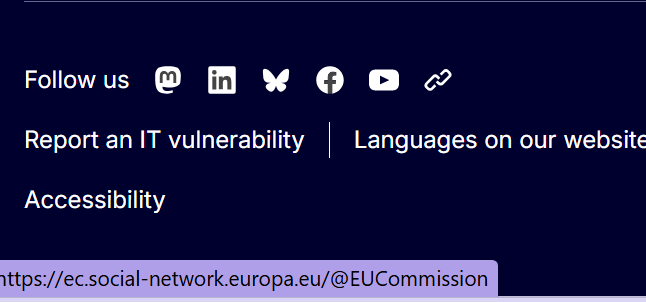
Excited to announce that the @EUCommission has updated it's follow buttons on the website footer!
What's that first platform there? Could that be #Mastodon?
And where did the link to #X go?
All the posts and comments here on Mastodon calling for this, trust me we read them!
#SocialMedia #EU #EuropeanCommission #FollowUs
Alt...
A screenshot from the European commission website footer.
the text "Follow us" is followed by the following icons:
- Mastodon
- LinkedIn
- BlueSky
- Facebook
- YouTube
- Link to more platforms
Underneath is says:
Report an IT vulnerability
Languages on our website
Accessibility
The convenience of synchronisation between devices are the most common argument that I hear from friends why they are so invested in the respective walled gardens. But the same advantages can be obtained with old well-tested and open standards. Example: get an SMS with e-mail, add it to contacts and then have it autocomplete in @thunderbird@mastodon.online connecting to whichever mail provider your heart desires, thanks to the magic of CardDAV and IMAP. No need for Giant Mail :)
It made me really appreciate the composability of CLI when I could type git remote add forgejo .../$(basename $(pwd)).git && git push ... to get that micro-automation going.
...
The original is written in #OCaml with quite involved setup, but #TIL about two single-executable #Rust implementations: Kodama and Weibian.
I'm still trying them out, but luckily both support @typst@mastodon.social so at least I can keep a common content format between them and final document
Trzy razy się przeprowadzić to jak raz spalić
Moving thrice is like having one fire#TIL a Polish saying
Well, once I became the person to guess that and I'm simply translating some textures with #Cpp everything is butter smooth again.